Training ·
SUP Training for Fighters: Balance, Cardio, and Strength
By Muay Thai coach, GymJoin co-founder
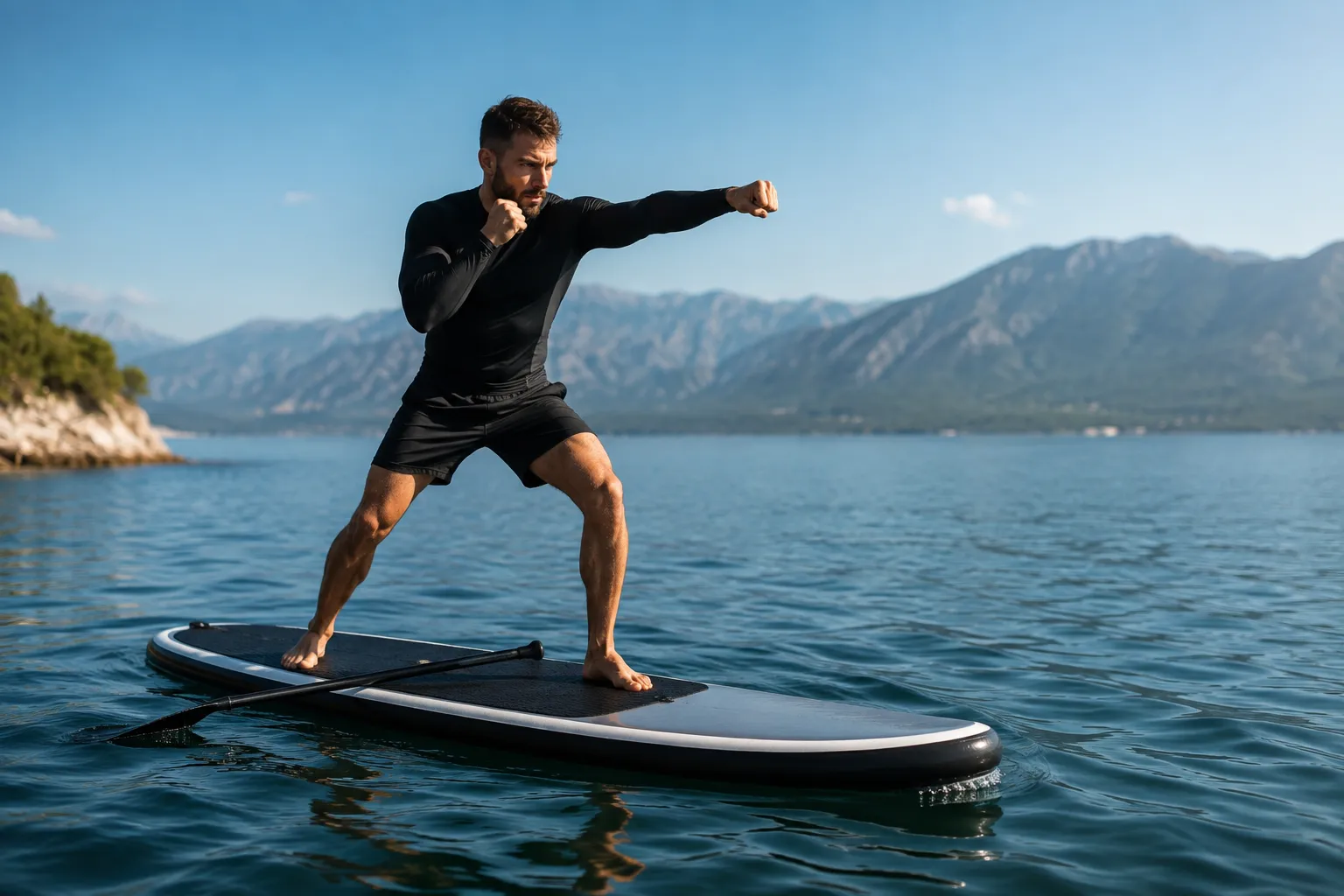
In the summer, stand-up paddleboarding (SUP) turns from a lakeside pastime into an effective cross-training tool for fighters in striking and mixed martial arts — Muay Thai, kickboxing, boxing, MMA. Training on an unstable water surface delivers a specific kind of load that’s hard to reproduce in a standard gym.
1. Aerobic and Anaerobic Cardio Without Impact
Every striking sport demands enormous cardio endurance. But running on asphalt or hard gym conditioning during summer puts extra strain on the joints and spine.
- Low-impact aerobic base (Zone 2): calm, sustained paddling on flat water lets you hold a heart rate of 130–145 bpm for hours, stretching the heart muscle and increasing lung volume without wearing down the knees.
- Interval anaerobic bursts: paddling in sprints against current or wind mirrors the rhythm of a fight in the ring or cage — a series of explosive, powerful strokes (zone 4–5) followed by a brief recovery phase.
2. Training Balance and a Sense of Equilibrium
For a fighter, balance is the foundation of everything: without it, you can’t land an accented strike, transfer force from the leg to the fist, stay on your feet defending a takedown, or throw a high middle kick or head kick.
- Center-of-gravity control: water reacts to the smallest shift in body weight. To keep the board from tipping, a fighter has to constantly control their center of gravity.
- Weight transfer: paddling drills the exact same weight shift from leg to leg used in footwork, slipping, or transitioning from defense to attack.
3. Strengthening Stabilizer Muscles and Ligaments
In the ring and on the mat, fighters often get injured from rolling an ankle or from instability in the knee and hip during sharp pivots.
- Deep proprioception: the constant wobble of the board forces the brain and nervous system to send micro-signals to the small muscles of the ankle and foot every second.
- A strong core: the abs, obliques, and spinal erectors work in continuous isometric tension on a SUP board, building a solid “corset” that protects the spine during throws and strikes.
4. Specific Load on the Shoulders and Back
Paddling on a board is a kinetic-chain exercise, where the effort starts in the legs, moves through the core, and transfers to the upper shoulder girdle.
- Lats and rhomboids: every correct stroke engages the back exactly the way it’s engaged when taking an opponent down in a clinch (especially in Muay Thai and MMA) or in cage-wall wrestling.
- Shoulder (deltoid) endurance: sustained paddling trains what’s known as “shoulder endurance” — this directly affects your ability to hold a high guard (hands by the jaw) in the final minutes of the last round, when your shoulders start to give out.
- Grip and forearm strength: constantly holding the paddle under load builds grip strength, which is critical for grappling.
5. A SUP Workout Complex for Fighters
Duration: 40–45 minutes. Gear: SUP board, paddle, safety leash.
Warm-up (5–7 minutes)
- Calm paddling on your knees (2 minutes) to get used to the water.
- Rise into a standing position, paddle at an easy pace, and rock heel-to-toe to wake up the ankles.
Main Block (3 Rounds)
1. Power sprints (anaerobic burst)
- Exercise: 10 maximum-effort strokes on one side + 10 on the other (maximum speed and stroke power).
- Rest: 45 seconds of calm drifting.
- Repeats: 4 sets in a row.
2. Strength block on the board (isometrics and stabilization)
- Push-ups on the board (12–15 reps): hands on the board, the board rocking on the water — maximum focus on the chest and core.
- Fighting-stance squats (10 per leg): feet shoulder-width apart, holding balance through a smooth range of motion.
- Forearm plank (45 seconds): you can add light rocking of the board with your torso.
3. Clinch pull (lat work)
- Exercise: deep, powerful strokes with the paddle blade fully submerged, working against current or wind for 3 minutes without stopping (mimicking a round of clinch fighting).
Cool-down (5 minutes)
- Slow, easy paddling to bring your breathing back down.
- Light stretching of the shoulder girdle and hip muscles right on the board.
6. Mental Relief and Nervous System Recovery
Spending time in a closed gym, the constant noise of bags being hit, sparring, and repetitive loads all build up mental fatigue and overload the central nervous system (CNS).
- The “white noise” of water and open space: a calm body-of-water environment lowers cortisol levels (physical stress).
- A shift in attention: the need to hold your balance forces the brain to focus completely on the sense of your own body in the here and now, pushing out thoughts about an upcoming tournament or hard sparring sessions. It’s one of the best ways to prevent burnout during a tough summer training camp.
7. Vitamin D Synthesis and Natural Cooling
- Hormonal optimization: training in open sunlight during the day or morning stimulates vitamin D production, which plays a key role in testosterone synthesis, bone strength, and an athlete’s immune function.
- Thermoregulation: unlike a stuffy gym, there’s constant air movement on the water. Even during intense effort, the risk of overheating is lower (with a hat and drinking water on hand), and the ability to dip into the water at any moment gives you quick, natural muscle cooling.
Conclusion
SUP training won’t replace dedicated pad work or sparring, but it’s a highly effective addition to a fighter’s general physical preparation over the summer. It gently builds the cardio system, forges rock-solid balance, strengthens the joints and back, and at the same time gives the central nervous system the mental break and quality recovery it needs.